How to Launch a Wellness Brand: What You Need, Who Should Build It, and What to Avoid
Launching a wellness brand takes more than a good formula, and who builds the brand shapes the outcome as much as what goes into it.
What does it take to launch a wellness brand?
Launching a wellness brand takes five things: a clear position in the market, a name you can own, claims that hold up to regulators, a brand system that works on every surface, and a team that can build all of it as one piece. The formula matters, obviously. But the formula is rarely why a wellness brand fails. It fails because it looks like everything else on the shelf, says the wrong thing on the label, or launches with a site that can't sell.
The market is big enough to tempt a lot of founders. The Global Wellness Institute put the global wellness economy at $6.8 trillion in 2024 and projects it will reach nearly $9.8 trillion by 2029. That growth is real, and so is the crowding that comes with it. Every new supplement, skincare line, and functional drink competes with thousands of products that already have shelf space, reviews, and ad budgets.
We've written before about the surfaces a brand needs to go to market. This guide goes wider: the groundwork that comes before design, the decision most founders make without realizing it's a decision (who builds the brand), and how to choose a creative partner without spending a year and a second budget fixing the first attempt.
The groundwork that comes before design
The most expensive brand mistakes happen before anyone opens a design file. Three decisions set the ceiling for everything that follows.
Positioning: who it's for and why it wins
Positioning is the specific answer to "why would someone choose this over what they already buy?" Clean, effective supplements is not a position; half the category says it. Recovery support for women over 40 who train is a position, because a designer, a copywriter, and a media buyer can all build toward it. Before you brief anyone, write down who the product is for, what it replaces in their routine, and what you can claim that competitors can't. If that takes more than two sentences, the brand isn't ready to design yet.
A name you can actually own
A wellness brand name has to clear trademark searches, work as a domain and social handle, and survive the next five products you add to the line. Wellness is full of overlapping vocabulary (vital, pure, thrive, live well), and names built from those words are the ones most likely to draw a challenge from a larger brand after you've already printed labels. Screen early, before anyone gets attached. Our guide to naming a wellness brand for the long term covers the full process.
Compliance that shapes the brand from day one
In supplements especially, regulation isn't a final check. It's a design input. Structure/function claims like "supports joint comfort" or "promotes restful sleep" don't need FDA pre-approval, but the brand needs substantiation for each one and must notify the FDA within 30 days of first marketing a product that carries it. Any label with such a claim also needs the standard disclaimer stating that the FDA hasn't evaluated it and that the product isn't intended to diagnose, treat, cure, or prevent any disease.
Those rules decide what the front of the pack can say, how much room the back panel needs, and what your product pages and ads are allowed to promise. A brand that writes its tagline first and checks compliance later usually rewrites the tagline. Bring a regulatory reviewer in early (your manufacturer or a compliance specialist), and work with designers who already know where the lines are.
The brand system you need on launch day
A launch-ready wellness brand has six connected parts. Our design readiness checklist goes deeper on the first four. Here's the full picture, and what each part is actually for.
Brand identity
The identity is the rulebook every other surface follows: logo suite, color, typography, imagery direction, voice, and guidelines a printer or a future hire can use without guessing. A logo alone is not an identity. Brand identity work done properly starts with research into your audience and category, so every visual choice has a reason behind it.
Packaging
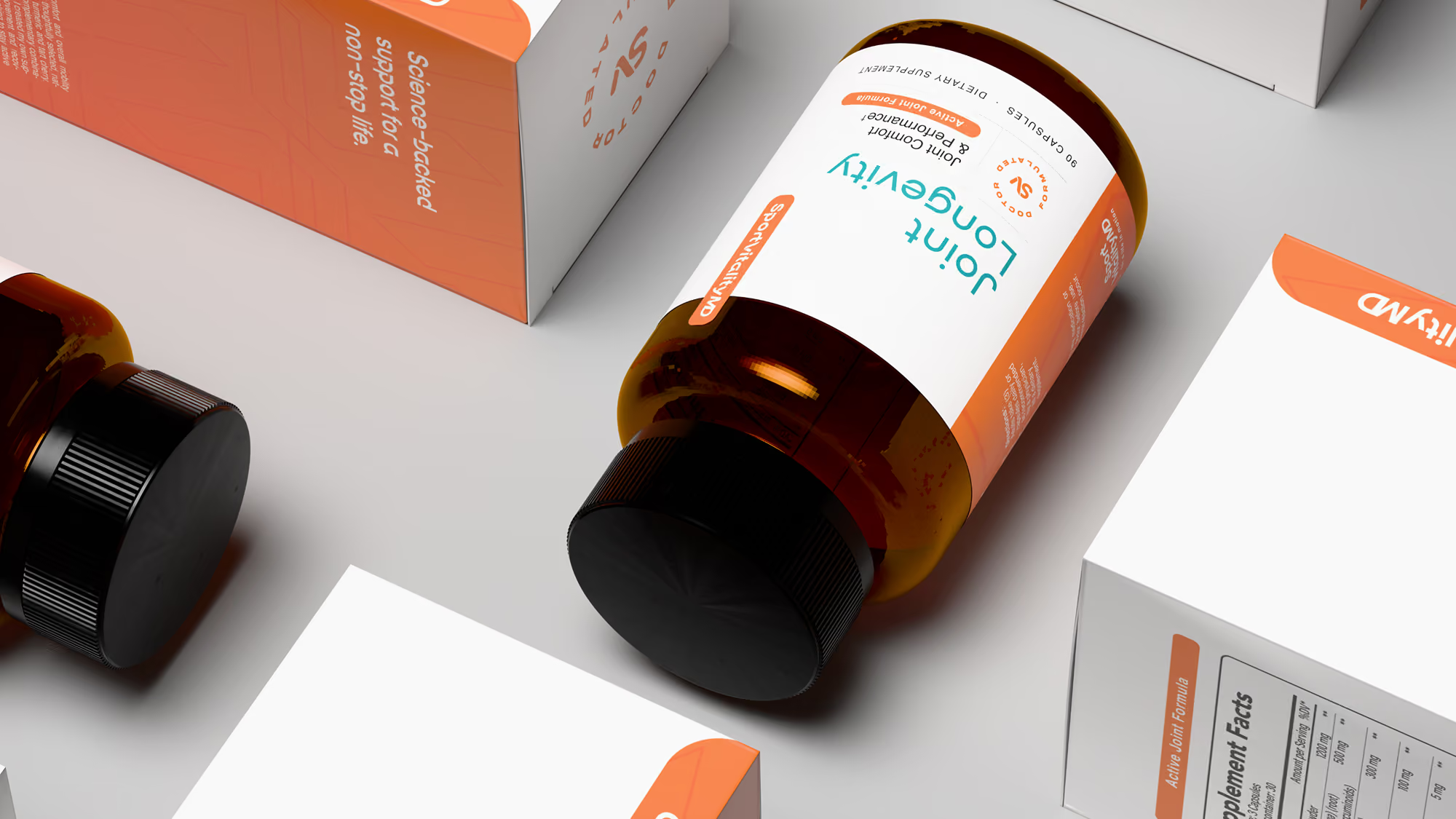
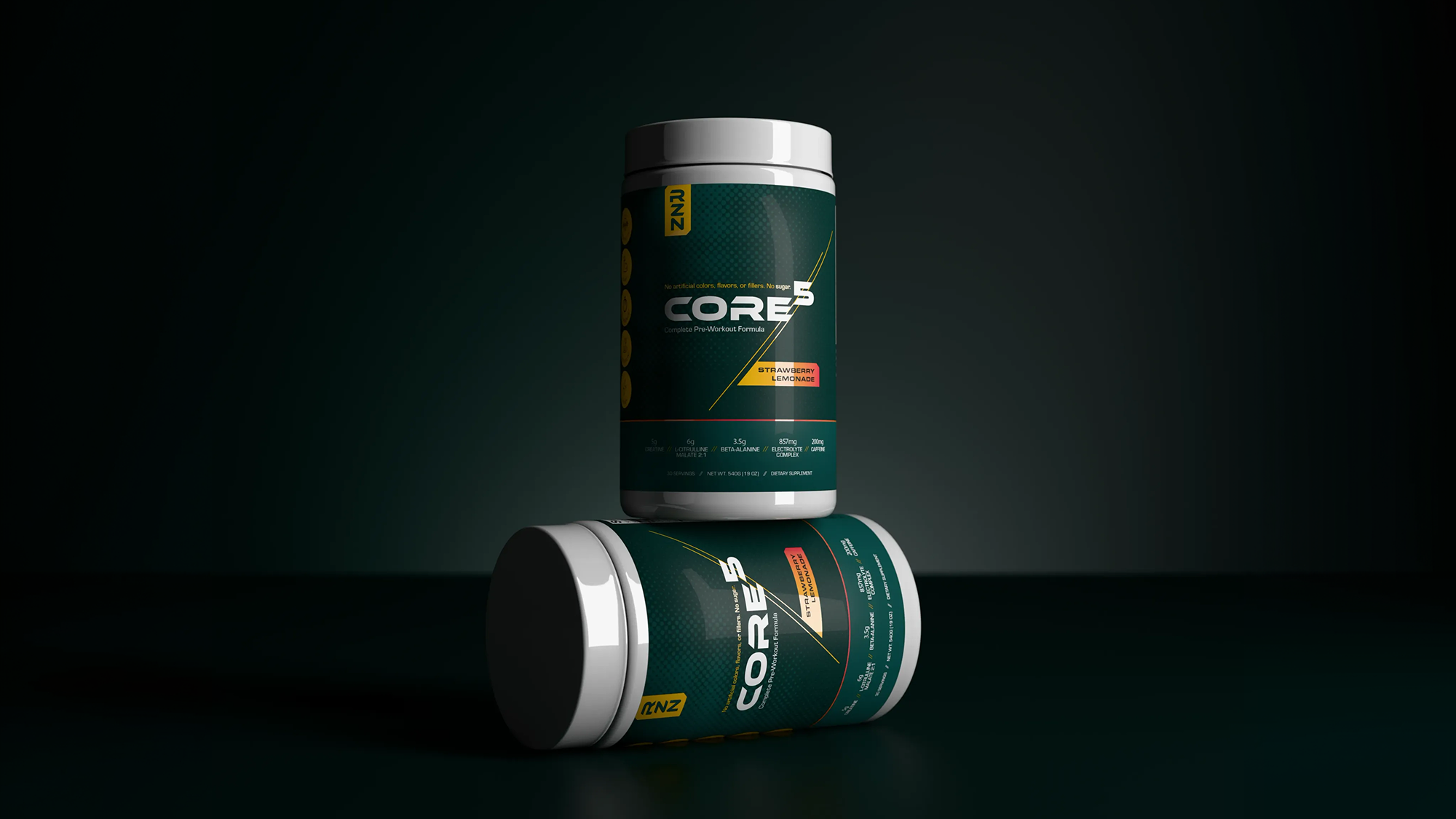
Packaging is where the brand meets its hardest constraints: a small surface, required regulatory copy, a manufacturer's dieline, and five competitors within arm's reach. Good packaging design builds a system that holds across every SKU and flavor, formats Supplement Facts correctly, and delivers press-ready files your printer can run without a week of back-and-forth.
A website that sells
For most new wellness brands, the site is the store. It needs product pages that answer the real objections (what's in it, why it works, who it's for), a checkout without friction, and copy that stays inside the same claim rules as the label. Website design for a product brand is a conversion problem first and a visual problem second.
Product visuals
Before inventory exists, renders do the heavy lifting: the homepage hero, marketplace images, ad creative, retail sell sheets. Photoreal product visualization built from real 3D models of your actual packaging lets you sell before the first production run lands, and keeps every channel showing the exact same product.
Email and launch marketing
A launch drives traffic once. Email is what turns that traffic into a second purchase. At minimum, a new brand needs a welcome flow, abandoned cart and browse flows, and a post-purchase sequence running before day one. We broke down which email flows to build before launch and which can wait. Email and digital marketing is where the brand system starts turning into revenue.
AI visibility
More shoppers now ask ChatGPT, Perplexity, or Google's AI Overviews what to buy before they ever search a brand name. Those tools answer from your site structure, product data, and published content. A new brand that sets up clean structured data and answer-ready pages at launch starts with an advantage older competitors have to retrofit. AI visibility is quickly becoming part of the launch itself, not something to bolt on later.
Should you use your manufacturer's design team?
For most wellness brands, no. A manufacturer's design service is convenient and usually cheap, and that's the problem. It's built to get a label on a bottle quickly, not to build a brand that stands apart. Here's why it tends to fall short:
- The work starts from templates. Many contract manufacturers openly advertise stock label templates where you swap in your logo and product name, with proofs the same day. Even "custom" packages are typically built on the same layouts, fonts, and conventions used for hundreds of other clients. It's a big part of why so many private label products look interchangeable.
- Design is the side business. A manufacturer makes its money on production runs. Design is an add-on that helps close the manufacturing deal, so it gets priced and staffed like one.
- There's no strategy behind it. Nobody asks who the product is for, what the competition looks like, or what position the brand can own. You get a label, not a brand.
- It stops at the bottle. Your website, renders, email, and ads still need someone else, which means the system starts fragmenting on day one.
- Ownership can be murky. Some arrangements leave source files with the manufacturer, which makes changing partners later slower and more expensive than it should be.
To be fair, manufacturer teams know their own dielines and the basics of label compliance, and that knowledge is useful. The smart move is to use it: get the specs, container dimensions, and regulatory guidance from your manufacturer, then have an independent designer build the brand. It's telling that many well-regarded manufacturers don't design in-house at all and refer founders to independent designers instead. They know the difference between producing a product and building a brand.
If you've already launched on a manufacturer template, it isn't fatal. The usual fix is a real identity system built underneath what exists, then a packaging refresh rolled out SKU by SKU.
Your options for building a wellness brand, compared
Founders generally choose between five routes. Each makes sense for someone. Only one or two make sense for a brand trying to compete on credibility.
Manufacturer design is the fastest and cheapest path to a printed label, and the most likely to produce a brand that looks like everyone else's. Fine for a test batch. Risky for a real launch.
Freelancers range from excellent to unreliable, and the good ones are usually specialists. A strong logo designer may not know Supplement Facts formatting; a strong packaging designer may not build Shopify sites. Hiring three freelancers means three interpretations of your brand, with you as the project manager stitching them together.
An in-house designer makes sense once a brand has steady volume. At launch, it means a full salary for one person who's unlikely to cover strategy, identity, packaging production, web development, and 3D rendering at a senior level. Most in-house teams still hire outside help for at least half of that list.
DIY and AI tools can help you explore a direction, and they're genuinely useful for showing a designer what's in your head. But AI tools learn from what already exists, so their output drifts toward the category average, which is the opposite of what a new brand needs. We cover this in why AI branding drifts toward the average. Supplement labels in particular should never be generated with AI. The Supplement Facts formatting and claims language are too exact to leave to a tool that guesses.
A creative studio costs more upfront than a template, and less than any other route once you count the redesigns, reprints, and rebuilds those routes tend to lead to. A good studio puts strategy, identity, packaging, web, and visuals under one team, which is the only reliable way to make them read as one brand.
How to choose a creative partner for your wellness brand
The right creative partner has worked in your category, starts with strategy before design, can carry the brand across every surface you'll launch on, and runs a process with clear checkpoints. Portfolio quality matters, but it's the minimum. Plenty of good-looking work comes from teams that can't get a label through production.
Category experience. Wellness, and supplements especially, come with rules a general branding agency learns on your budget. Ask to see printed packaging and live product pages, not just mockups.
Research before design. If the first conversation is about logos and the proposal has no discovery or positioning phase, the team is guessing at strategy.
The whole system, or a clear plan for it. A partner who designs your identity, packaging, and site together catches inconsistencies a handoff never will.
Production fluency. Dielines, color profiles, print proofs, Shopify builds. Beautiful work that can't be printed or launched is just a presentation.
Defined feedback rounds. Unlimited revisions sounds generous and usually means nobody is making decisions. Focused checkpoints produce better work, faster.
Questions to ask before you sign
- Which wellness or supplement brands have you taken from concept to print?
- What happens before design starts, and what do I approve at each stage?
- Do you handle Supplement Facts formatting and claims review, or coordinate with someone who does?
- Will the same team work on my packaging, website, and product visuals?
- Do I own all final and source files at the end?
- What does support look like after launch, when I add a SKU or a new channel?
Red flags to watch for
A flat logo price with no discovery phase. AI-generated labels. A portfolio of mockups with no printed product. A timeline that skips strategy entirely. A quote so low it can only come from a template. Any one of these deserves a follow-up question. Two or more is usually your answer.
How much does it cost to launch a wellness brand?
Design costs vary with scope, but realistic ranges make planning easier. At our studio, most branding projects start between $5,000 and $10,000 and take four to eight weeks. Packaging typically takes three to five weeks to reach print-ready files, and new SKUs added to an existing system take about a week each. Website, renders, and email come on top of that, and print lead times add their own weeks once files are final.
The bigger cost question is sequencing. Building in the wrong order (packaging before the identity is settled, a site before the packaging is locked) is how brands end up paying for the same work twice. We laid out the right order to build a brand in detail. The short version: strategy, identity, packaging, web, then visuals, with marketing set up before launch. Treat the brand build as a workstream that starts alongside formulation, not after it.
The cheapest option at the start is rarely the cheapest option by year two. A few-hundred-dollar template label that later has to be replaced, reprinted, and re-photographed costs far more than doing it right once.
Why a creative studio is usually the right call
A wellness brand gets judged in seconds, by someone comparing it to products they already trust. Credibility in that moment comes from consistency: the label, the site, the ad, and the unboxing all clearly belong to the same brand, and all of them look like a company that knows what it's doing. That consistency is very hard to get from a template, a rotating cast of freelancers, or a tool trained on everyone else's work.
A studio isn't the only way to launch. It's the way that gives a new brand the best chance of looking established on day one. We're a small team of senior designers and creatives with more than 20 years of experience, and that's how we build: strategy first, every surface designed as one system, and files you own at the end. The formula gets you a product. The system is what gets someone to pick it up.
Have a project in mind?
Tell us what you're making. Half-formed idea, full-blown launch, or somewhere in between — we're happy to talk it through.